Church and civic power
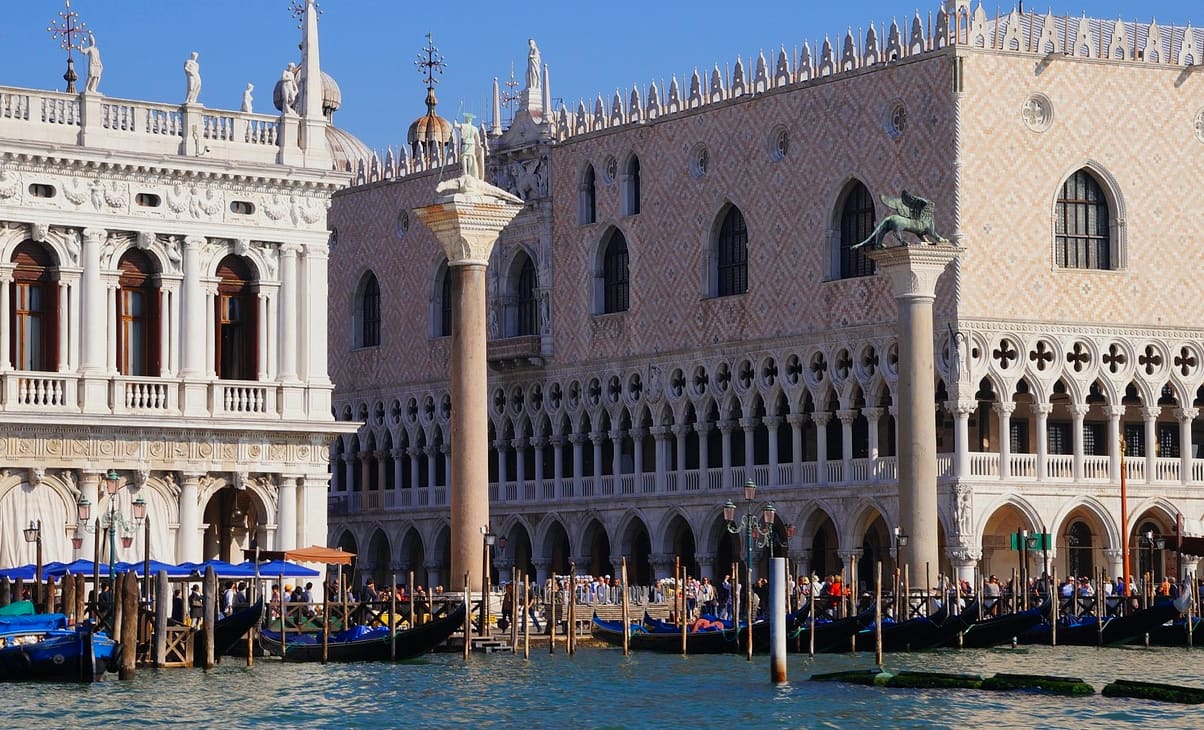
The basilica anchors one end of the Piazza. Beside it, the Palazzo Ducale, or Doge’s Palace, evokes Venice’s historic government. Its relationship to the church makes the proximity of religious and civic authority visible in the city’s plan.
The Ponte dei Sospiri, or Bridge of Sighs, is associated with the palace complex. It is distinct from the open space of the Piazza: approaching the waterfront helps place it within the surrounding network of buildings and canals.
Time and height
The Campanile is the square’s tall bell tower and a prominent landmark when navigating the area. The Torre dell’Orologio, or Clock Tower, provides a different kind of orientation on the edge of the Piazza. Compare the vertical emphasis of the Campanile with the clock tower’s place within the surrounding built frontage.
Towards the lagoon
The Piazzetta leads from the Piazza towards the water and the historic columns of Saint Mark and Saint Theodore. Beyond, the Riva degli Schiavoni follows the waterfront. This change from enclosed square to open lagoon gives the ensemble a distinctive spatial rhythm.
Collections around the Piazza
The Museo Correr and the Biblioteca Nazionale Marciana add collections and scholarship to the area’s civic and architectural story. Their presence is a useful reminder that San Marco is not only a view, but also a place where historical material is studied and cared for. Current access arrangements are not provided in this guide.